|
Purchasing
and transporting sand from commercial sources (from licensed dredging sites
south of the Isle of Wight or at the Thames Estuary) can be very expensive. So
when an opportunity arises to utilise sand from local dredging operations it
saves Defra - and consequently the taxpayer - a considerable sum of money.
Poole Harbour Commissioners (PHC)
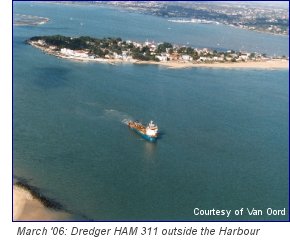
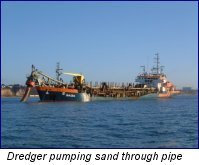
dredged 2 million m3 of
material from Poole Harbour Channels and Approaches, of which about 1.1 million
m3 was suitable for beach replenishment.
The
remainder of the material (silts and clays) were disposed of under licence at
an offshore disposal ground located off Swanage. PHC have utilised this site for the disposal of dredged
material from Poole Harbour for more than 50 years.
The
dredging was necessary to deepen the harbour approach and channels from the
present 6m to 7.5m below Chart Datum and by doing so secure the long-term
viability of the Port. It was also
necessary to widen the Middle Ship Channel to 100m.
Primarily,
the deeper approach channel was required to meet the needs of modern ferries, the
majority of which now have a minimum draft of over 6.5 metres.
In
2003 Brittany Ferries advised Poole Harbour Commissioners that they would be
withdrawing the freight ferry M/V “Coutances” from the Poole/Cherbourg
service due to the age of the vessel. The
“Coutances” will be replaced with a vessel built to carry both freight and
passengers. It will be of a similar
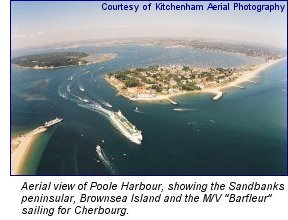
design but larger than the M/V “Barfleur” that also operates out of Poole.
Poole Harbour is internationally
recognised as a sensitive environment in terms of wildlife, geology and
landscape. It is also important for
recreational boating and supports a significant fishing industry.
In view of this, and in accordance with
the Harbour Works Regulations 1999, a full Environmental Impact Assessment (EIA)
was carried out by Posford Haskoning on behalf of PHC and the local authorities. The document is available to download from the PHC website
(see ‘Sources of Further Information’ below).
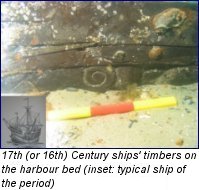
The EIA study and other extensive
assessments of the likely effects of the channel deepening on, for instance,
habitats, archaeology and water quality, has resulted in one of the most
significant investigations ever undertaken into the morphology of Poole Harbour.
|



















 During
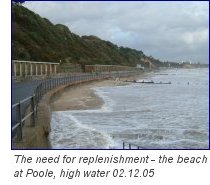
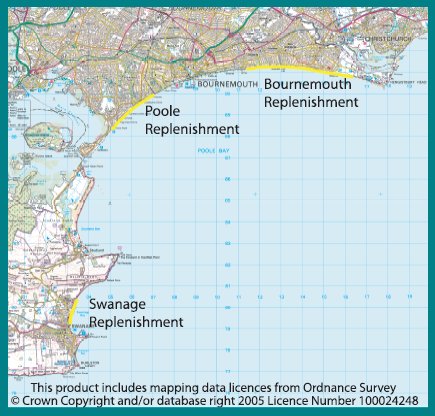
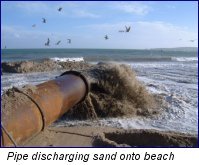
the winter of 2005/2006 approximately 1.1 million cubic metres (1.65 million metric tonnes) of sand dredged from Poole Harbour channels
and approaches was used to replenish beaches at Swanage, Poole & Bournemouth to protect them from erosion.
During
the winter of 2005/2006 approximately 1.1 million cubic metres (1.65 million metric tonnes) of sand dredged from Poole Harbour channels
and approaches was used to replenish beaches at Swanage, Poole & Bournemouth to protect them from erosion.