




The Poole Bay Partnership
Poolebay.net was first published in response to the high level of public interest
in the major beach replenishment projects of 2005-
Copyright © 2005 -



Other sources of local coastal information

These pages contain only archived material


Poole Bay Nearshore Beach Replenishment Trial 2015
Borough of Poole has been awarded £260,000 funding to trial a beach replenishment process that could make future projects more economically and environmentally sustainable.
The trial, endorsed by the Environment Agency both locally and nationally, and supported by SCOPAC (Standing Conference on Problems Associated with the Coastline) involves Borough of Poole working in partnership with Poole Harbour Commissioners, the Environment Agency, Southampton University and the Channel Coast Observatory.
Project Funding
Funding has been provided by:
- Environment Agency: £130,000 for the placing of sand on the seabed; the Marine Management Organisation (MMO) has granted a licence to allow this operation.
- Environment Agency Research & Development Fund: £115,000 for monitoring
- SCOPAC: a further £15,000 towards monitoring costs
Monitoring
- Beach levels will be surveyed before, during and after the trials;
- Multibeam swath bathymetry surveys before, during and after the project will generate 3D images of the seabed and demonstrate how the beach material has moved;
- An Acoustic Doppler Current Profiler (ADCP) will measure the speed and direction of water currents and turbidity;
- Wave height, direction and spread and sea temperature will be monitored at the Boscombe
wave buoy by the Channel Coast Observatory [real-
time data available here ] - Silt Traps (vertical tubes measuring 40cm x 8cm) will monitor changes outside the immediate area of works. Southampton University have used silt traps in the bay previously whilst carrying out marine habitat surveys during Channel deepening projects, and will return to instal them at 3 sites across the study area, to be replaced and measured on a monthly basis; sites are shown on the detail map (right)
- Luminescent Sediment Tracers (fluorescent painted sand) will be used to track movement of sand over a period of months.
Measuring success
The success of the trial will be measured by:
- Having little to no effect on the Poole Rocks MCZ (Marine Conservation Zone, designated November 2013 and marked in green on the detail map, right)
- Movement of the material towards the foreshore
- Reduction in beach erosion, and
- The economic viability of near-
shore renourishment.
Notes
Conventional beach renourishment, pumping sand ashore and spreading it using land-
The trial site has been selected owing to its position at the up-
Monitoring will be undertaken by the Channel Coastal Observatory (CCO) funded by the Environment Agency Research and Development Fund.
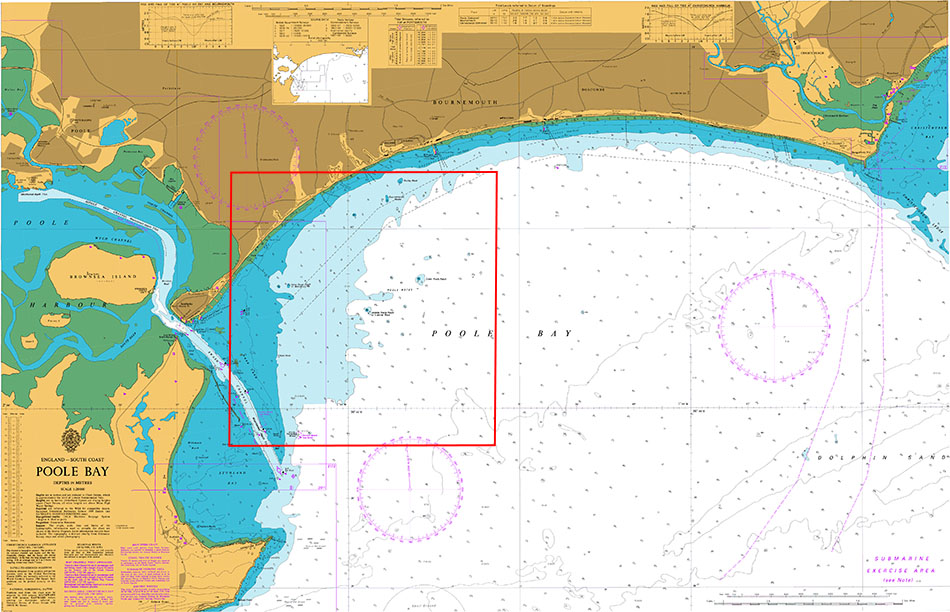
Poole Bay overview: the area shown in the detail map (below) is marked in red
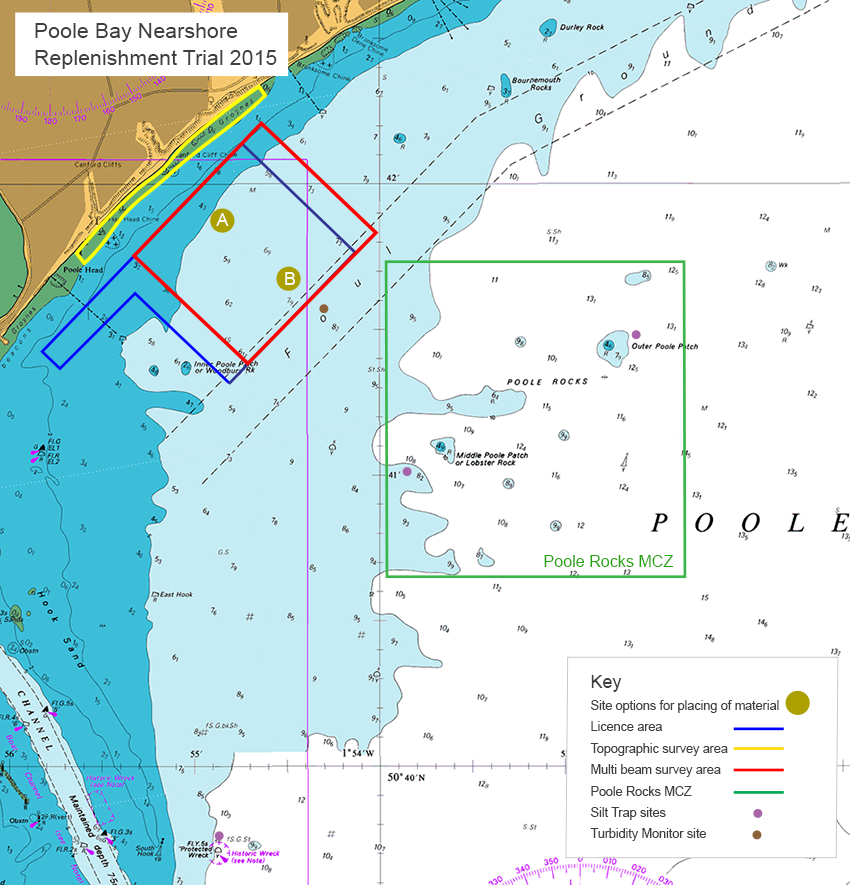
Detail map approximately 30,000 cubic metres of dredged material as close as possible to site A on a set grid pattern.
|
Index |